Stop Re-Reading, Start Generating: The Science of Learning by Output
Re-reading feels productive but coasts on recognition. Learning science says the opposite works: set a goal before you read, then generate the answers instead of consuming them.
I've lost count of how many times I've read a page, nodded along, felt like I understood it — and then completely blanked when I needed it later. Re-reading feels productive. It's comfortable. But that comfort is exactly the problem: when the material is sitting right there in front of you, your brain coasts. It recognizes the words and mistakes recognition for knowing.
Reading is input. Learning needs output. And there's a good deal of cognitive science explaining why.
The comfort of re-reading is an illusion
The uncomfortable truth is that re-reading is one of the least effective things you can do with your study time. When five researchers reviewed ten common study strategies for a landmark report, they rated re-reading — along with highlighting and summarizing — as low utility. Only two techniques earned the top rating: practice testing and spacing your study out over time (Dunlosky et al., Psychological Science in the Public Interest, 2013; accessible summary).
Yet re-reading remains the strategy students reach for most. In a survey of undergraduates, 84% listed re-reading as a study strategy and 55% ranked it as their number one — while only 11% reported testing themselves at all (Karpicke, Butler & Roediger, Memory, 2009).
Why the gap? Because re-reading produces a feeling of fluency. The text gets easier to process each pass, and your brain reads that smoothness as "I know this." Cognitive scientists call it the illusion of competence: the warm familiarity of recognizing words on a page is reporting the ease of recognition, not the durability of recall. It feels like learning. It mostly isn't.
Generating beats consuming — the generation effect
Here's the flip side, and it's one of the most robust findings in memory research. Back in 1978, Norman Slamecka and Peter Graf ran five experiments comparing words people read against the same words people had to generate themselves — filling in a target from a rule and a first letter rather than just being shown it. Across every measure — recognition, free recall, cued recall — the words people generated were remembered better. They named it the generation effect (Slamecka & Graf, Journal of Experimental Psychology, 1978).
The act of pulling something out of your own head — even partially, even effortfully — encodes it more deeply than having it handed to you. This is why the study techniques that actually work all share one feature: they make you produce the information instead of consume it.
The most direct version is the testing effect. Roediger and Karpicke had students study a passage and then either re-study it or take a no-feedback practice test. Five minutes later, re-studying looked better. But on the tests that actually mattered — two days and a week out — the students who had tested themselves remembered far more (Roediger & Karpicke, Psychological Science, 2006). Re-reading wins the short-term illusion; retrieval wins the exam.
Decide what you want before you open the material
There's one more shift that changes everything, and it happens before you read a single word: being intentional about what you want to walk away being able to do.
Instead of "I'm going to read this chapter," decide "I want to be able to answer these three things by the end." That reframing turns passive reading into a hunt — you're reading to find answers, not just to pass your eyes over words.
The research backs this up in a surprising way. Richland, Kornell, and Kao had students read a passage; some were quizzed on its key concepts before reading — questions they couldn't possibly answer yet. On the final test, the pre-tested group did better, even on the exact items they'd gotten wrong on the pretest (Richland, Kornell & Kao, Journal of Experimental Psychology: Applied, 2009). The failed attempt to answer primed their attention and told their brain what mattered. Asking the question first — even with no hope of answering it — made the reading stick.
The playbook
Put it together and re-reading isn't part of the plan at all:
- Set the target first. Before you open the material, write down the two or three things you want to be able to answer by the end. Study toward them.
- Read once, with purpose. A single focused pass hunting for those answers beats three passive re-reads.
- Then generate. Close the book and produce: turn the material into questions, write a summary in your own words, explain it aloud, make flashcards. Anything that forces the information out of your head.
- Embrace the discomfort. Generating is harder and slower than re-reading, and it feels worse in the moment. That struggle is the signal it's working — the effort is the learning.
- Come back and do it again, spaced out. Quiz yourself the next day, then a few days later. Spacing is the other top-rated technique for a reason.
If you finish a session and you haven't generated a single thing — not a question, not a note in your own words, nothing — you've probably just been re-reading.
Skip the busywork of making questions
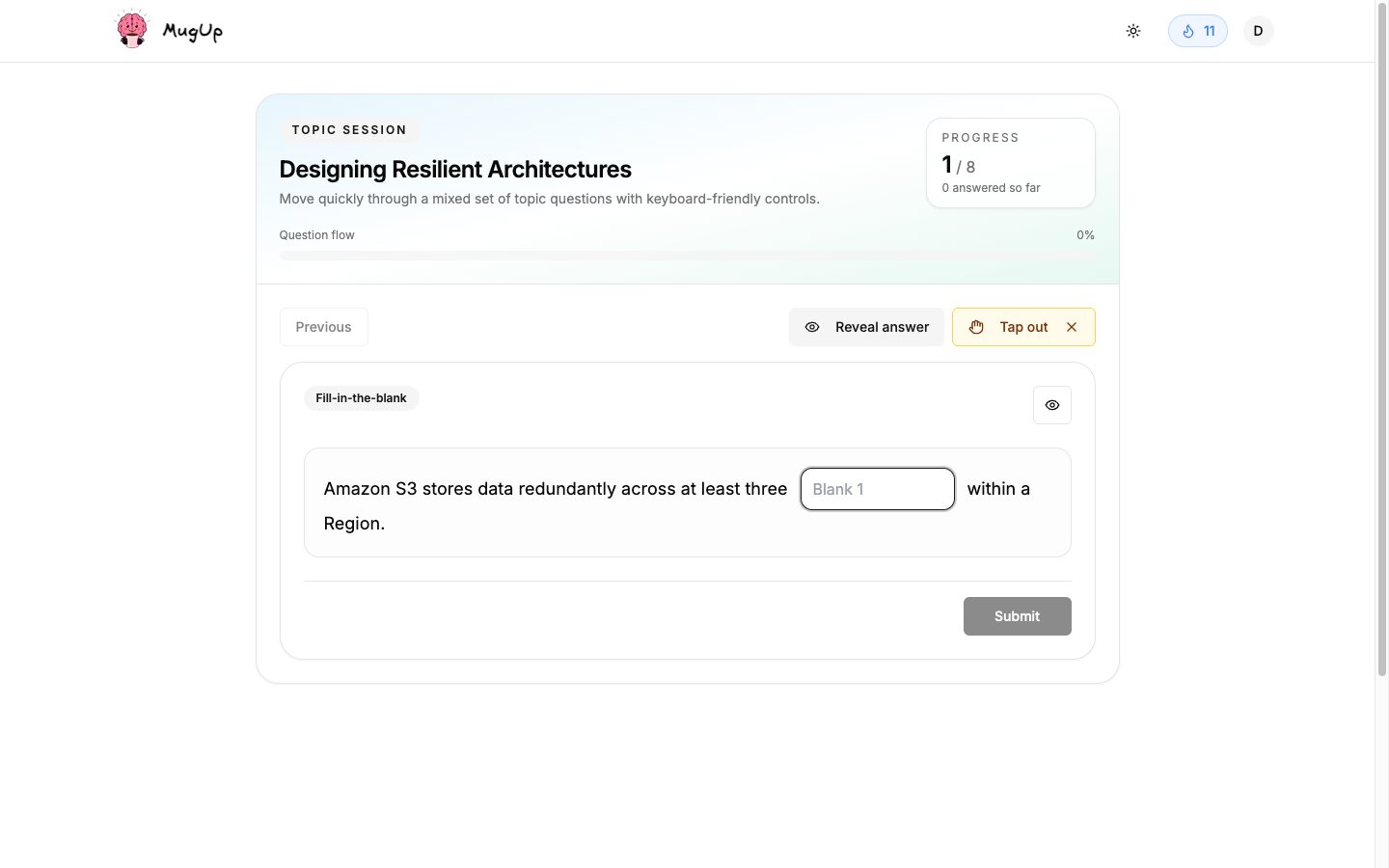
The one real friction in generating is making the questions in the first place, and that friction is exactly why so many people fall back on re-reading. That's the job MugUp does for you: paste in any topic and it instantly builds quizzes, flashcards, fill-in-the-blanks, and matching games — so you spend your time producing answers, not formatting cards.

Start free and turn your notes into something you can quiz yourself on today.
The takeaway
Reading something twice is not the same as learning it. Recognition is not recall, and the comfort of a familiar page is an illusion. Decide what you want to walk away being able to do, read once to find it, and then make yourself generate the answers. You'll forget a lot less.
Want the deeper dive on self-testing? Read why quizzing yourself is the best way to study, or see how to build a routine around it for USMLE Step 1.
Sources
- Dunlosky, J., et al. (2013). Improving Students' Learning With Effective Learning Techniques. Psychological Science in the Public Interest.
- Karpicke, J. D., Butler, A. C., & Roediger, H. L. (2009). Metacognitive strategies in student learning: Do students practise retrieval when they study on their own? Memory.
- Slamecka, N. J., & Graf, P. (1978). The Generation Effect: Delineation of a Phenomenon. Journal of Experimental Psychology: Human Learning and Memory.
- Roediger, H. L., & Karpicke, J. D. (2006). Test-Enhanced Learning: Taking Memory Tests Improves Long-Term Retention. Psychological Science.
- Richland, L. E., Kornell, N., & Kao, L. S. (2009). The Pretesting Effect: Do Unsuccessful Retrieval Attempts Enhance Learning? Journal of Experimental Psychology: Applied.
Turn this into a game
Type a topic and MugUp's AI builds quizzes, flashcards, and matching games in seconds. Free to start.